IC.
GITHUBGH LINKEDININ
SYSTEM 004 · CURRICULUM VIDEO PIPELINE · IN PRODUCTION

AI Content Studio.

Shikho's academic team self-serves curriculum-true animated videos and interactive physics simulations. Governed by a 14-axiom academic constitution - correctness is enforced, not hoped for.

INTERNAL SYSTEM · REAL INTERFACE, PROTECTED DATA · WALKTHROUGH AVAILABLE ON REQUEST
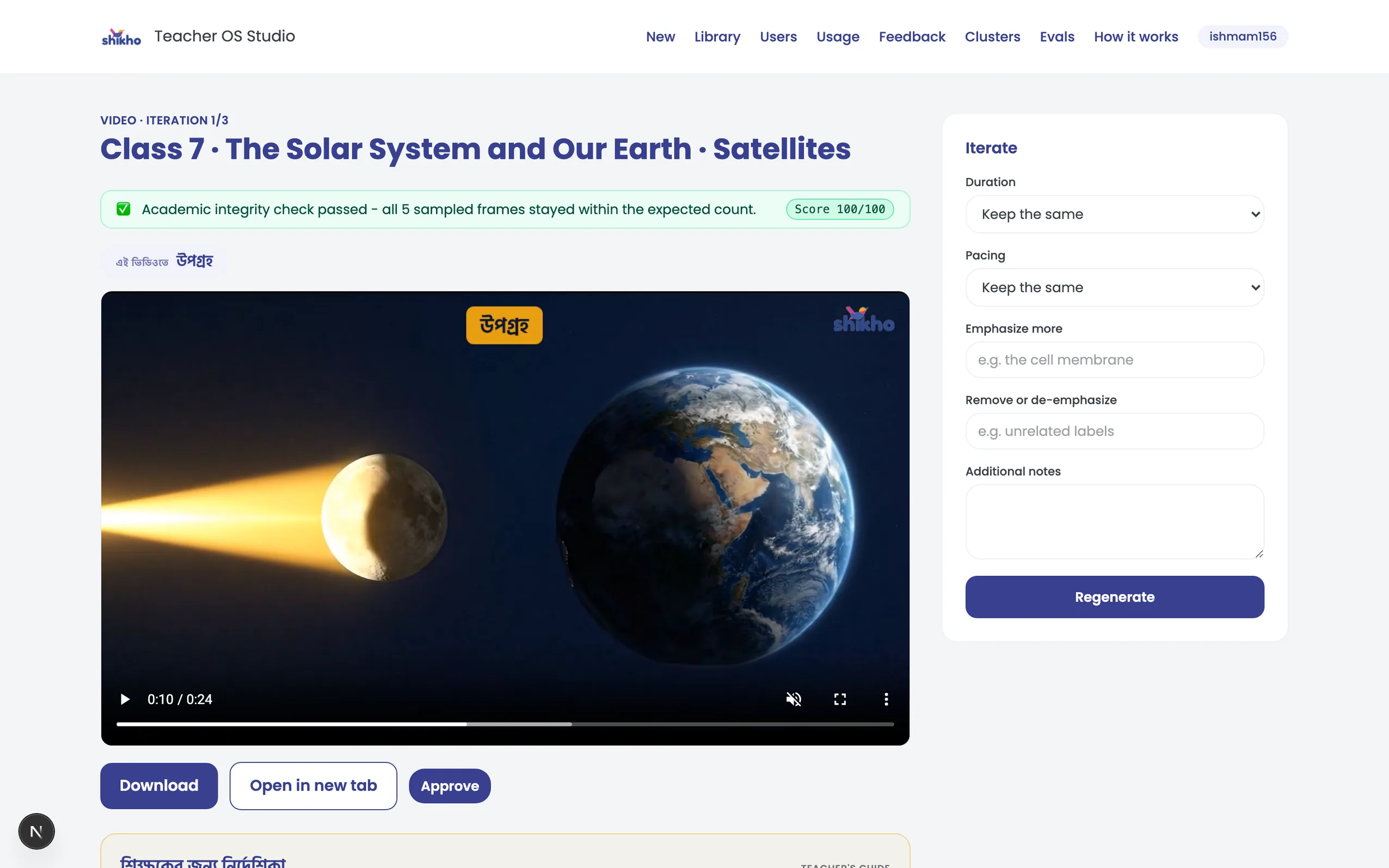
ai content studio · internal · real UI
AI Content Studio - a generated Solar System lesson playing mid-frame, integrity score 100/100
01 · THE PROBLEMWHAT WAS BROKEN

One classroom animation used to need a researcher, a storyboard writer, an animator, a cross-checker, and edit loops between them. Different people, days of coordination, real money - per topic.

02 · THE SYSTEMWHAT SHIPPED · WHO USES IT
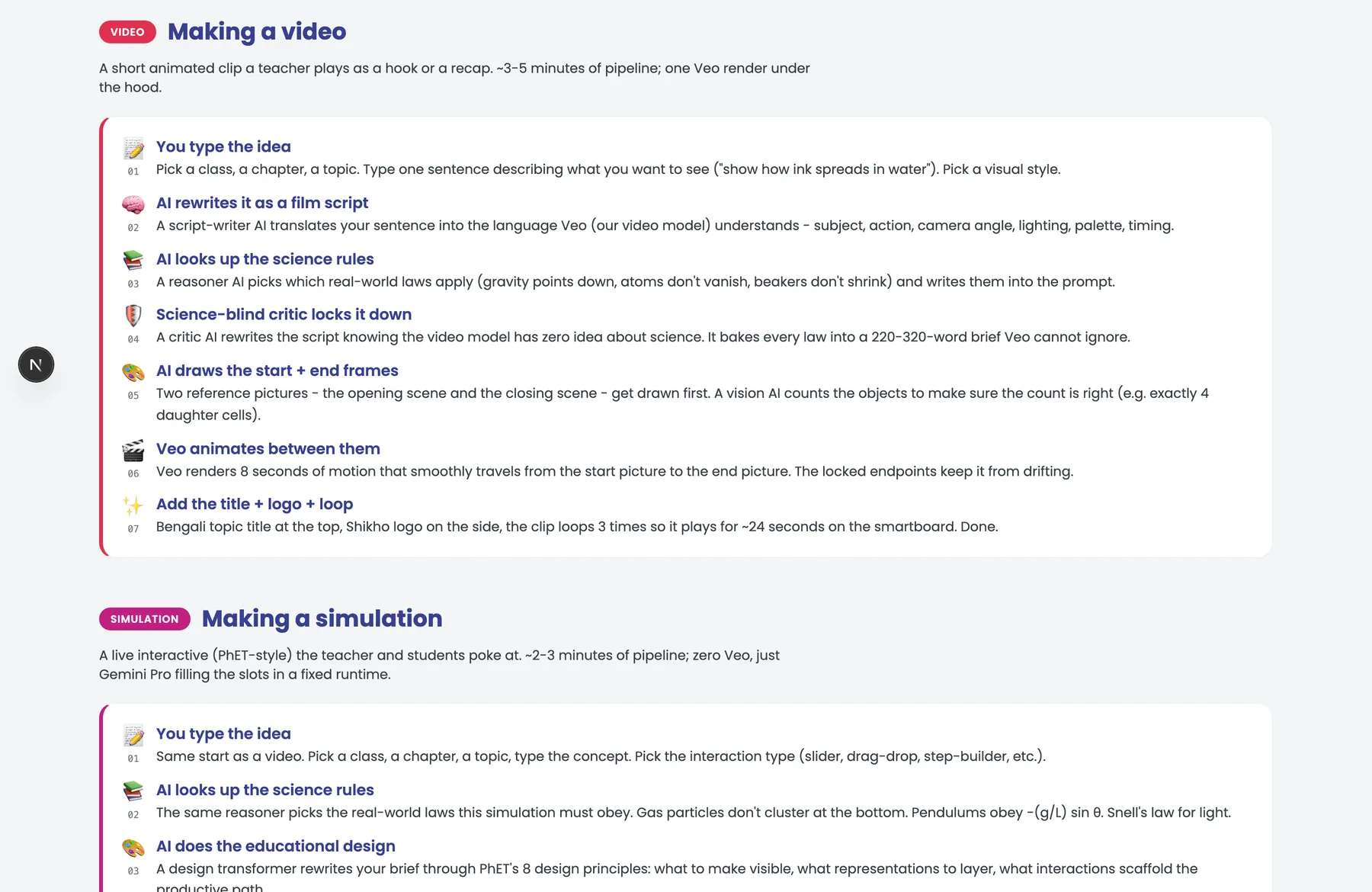
The studio's own How-this-works page - the seven-step video pipeline in plain EnglishThe creation wizard - type, class, topic, promptA passing render - the rotating Earth lesson frame

REAL STUDIO SCREENS · THE PIPELINE · THE FORM · WHAT COMES BACK

The academic team types class, chapter, topic - and gets back a curriculum-true animated video or an interactive simulation. 637 real generations at $3.71 average; 119 approved for classroom use so far.

What changed: a four-role pipeline - researcher, storyboarder, animator, checker - became a form.

637real generations
119approved for classrooms
$3.71average per generation

SOURCE: Usage dashboard · July 2026

03 · UNDER THE HOODWHAT ACTUALLY HAPPENS

Pick a moment. This is what the system does with it - every step a deliberate call, none of it visible from the outside.

01
A teacher's one-line brief becomes a film script - then the chapter's knowledge pack attaches the laws: what this topic's end state must look like, what it must never look like, which misconceptions to steer around.
curriculum laws attach
02
An adversarial critic attacks the script before anything renders - hardening it against the video model's known bad habits: inventing extra objects, drifting colours, fake on-screen text.
a critic plays devil's advocate
03
Three cheap checks run before the expensive render: predict the final frame and compare it to the laws; verify the subject is present in both keyframes; count the objects in the end frame. Each gets exactly one retry - a fraction-of-a-cent vision call versus a wasted four-dollar render.
3 gates before the $4
04
The video renders eight seconds between two locked keyframes so it cannot drift off either end - then loops into an 18-second lesson with a Bangla title chip, drawn through a renderer that survives Bengali conjuncts.
8s rendered, 24s played
05
THE CLEVER BITthen it grades its own homework: five frames sampled, five weighted dimensions scored, threshold 85 - and a physics violation like reversed motion caps the science score so hard the video cannot pass. A wrong video holds itself back, with a visible score out of 100. The automatic no.
the integrity gate
04 · WHY NOT ONE PROMPTWHAT A ONE-SHOT WOULD HAVE GOT WRONG

"Make educational videos with AI" is a one-prompt idea. Making them curriculum-true at four dollars a render is not.

  1. Stochastic models do not respect physics. Veo happily reverses motion, invents extra daughter cells, and recolours limewater. Every axiom in the 14-rule constitution and every named trap exists because a specific wrong render was watched, and paid for.
  2. The knowledge had to be built, not assumed. 55 curriculum packs grounded in the actual NCTB textbooks - researched by an agent swarm, cited, version-controlled - give the system the one thing no model reliably knows: what Class 7 in Bangladesh is actually taught.
  3. Cost discipline is a design layer. Three pre-render gates each capped at one retry, renders looped instead of lengthened, a hard kill switch on experiment spend - engineering against a real per-render price.
  4. The failure loop feeds the system. Teacher complaints are minted into new eval cases, and a weekly human audit keeps the AI judge honest. A one-shot has no way to learn from its own misses.
05 · THE DIRECTIONWHERE THE HUMAN WAS
THE FORK · WHAT THE AI PITCHED VS WHAT I SENT

Days into the simulation feature, the pipeline asked the model to write each simulation as a full HTML app from imagination - and every render invented a new class of bug. His verdict on the output, verbatim: "Lastly, for the lack of a better word, the simulation looks like absolute shit.

PhET Interactive Simulations is like the gold standard, they have so many great simulations - and a lot of it is open to use."

THE MODEL, CALLING ITS OWN ARCHITECTURE · AFTER THE REDIRECT

You're right - the fix loop is fighting the wrong battle. The root cause is non-deterministic scaffolding from Gemini; standardizing the scaffold from PhET's actual practice eliminates the class of failures we're patching after the fact. [...] Got the research. Calling it: **Option B (mini-PhET runtime) shipped as the deterministic shell, with Gemini reduced to filling slots**.

WHAT I SENT · THE REDIRECT

I think we are overcomplicating the code generation part of the simulation - that is causing the root problem, which we are then struggling to fix.

A better approach might be to digest - https://github.com/orgs/phetsims/repositories [...] /goal - ingest the simulations, truly deeply study them, find out and create our systematic version of this so that we have a more deterministic system rather than based on whatever the prompts give us.

The playbook is now code: PhET's eight design principles hard-coded into the design pass, a deterministic mini-runtime owning everything structural, and the model reduced to four typed slots it cannot break.

SESSION TRANSCRIPT · 2026-05-16 · BOTH SIDES QUOTED EXACTLY · [...] MARKS OMITTED SPEECH

Don't patch a wrong approach into submission. Go study how the best in the world standardized it - then make that the system.

49 append-only decision records14-axiom constitutionweekly Friday auditsmisses become eval casesHOW IT WAS RUN, NOT HOW IT WORKS